


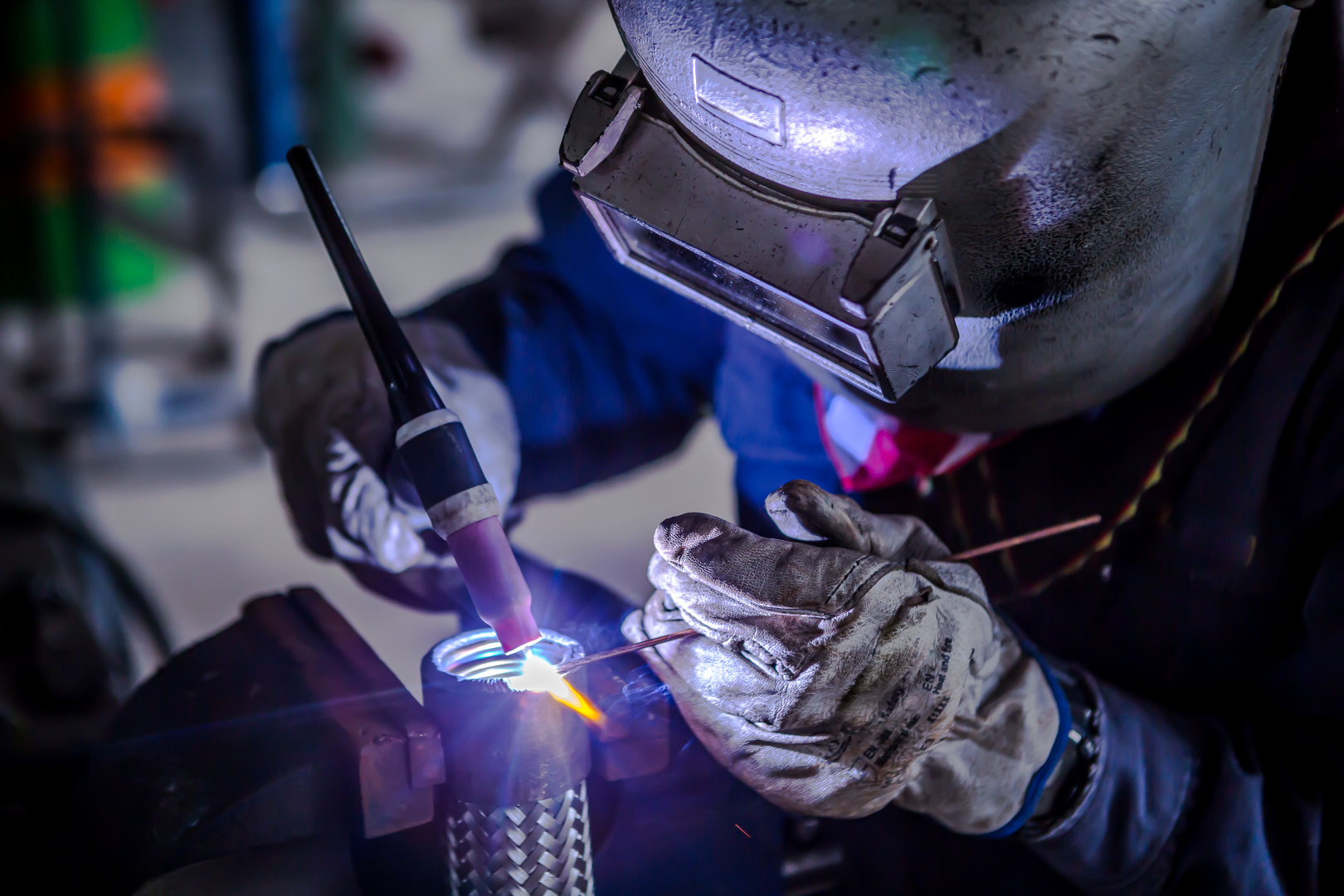
Welding is the main focus of steel fabrication. Formed and machined parts are assembled and tack-welded in place, then rechecked for accuracy. If multiple weldments (an assembly joined by welding, sometimes referred to as “welding assembly” and “welding structures“) have been ordered, a “welding fixture” may be used to position product parts for welding. This secures the geometry of the product parts. A welder finishes the work according to engineering drawings (for detailed welding) or by their own experience and judgement (if no drawings are supplied).
Special measures may be needed to prevent or correct warping of weldments due to heat. These may include redesigning the piece to require less welding, employing staggered welding, using a stout fixture, covering the weldment in sand as it cools, and post-weld straightening.
Straightening of warped steel weldments is done with an oxyacetylene torch. In this highly specialised work, heat is selectively applied to the steel in a slow, linear sweep, causing the steel to contract in the direction of the sweep as it cools. A highly skilled welder can remove significant warpage this way.
Steel weldments are occasionally annealed in a low-temperature oven to relieve residual stresses. Such weldments, particularly those for engine blocks, may be line-bored after heat treatment.


